School of Education
School of Nursing and Health Innovations
School of Business
Graduate School

Doctor of Nursing Family-Nurse Practitioner Program under new leadership
New Graduate Program Director shares her vision, some practical advice for prospective students, and a hint for the future.
Key takeaways
- Vision for the Doctor of Nursing Practice, Family Nurse Practitioner program: Intentional growth and sustainability.
- DNP vs. MS: The master's degree is typically focused on direct clinical practice, while the DNP is a terminal degree focused on patient care, leadership, policy, and translating research into practice.
- Small cohort size: We keep our DNP program cohorts intentionally smaller to ensure faculty student mentoring and time to develop relationships.
- Flexible learning model: Our program is flexible with a hybrid model for working professionals with 1-3 weekend immersions.
- A new graduate nursing program on the horizon: Stay tuned for more on this in the coming months.
Chris Harsell steps into the Nursing Graduate Program Director role
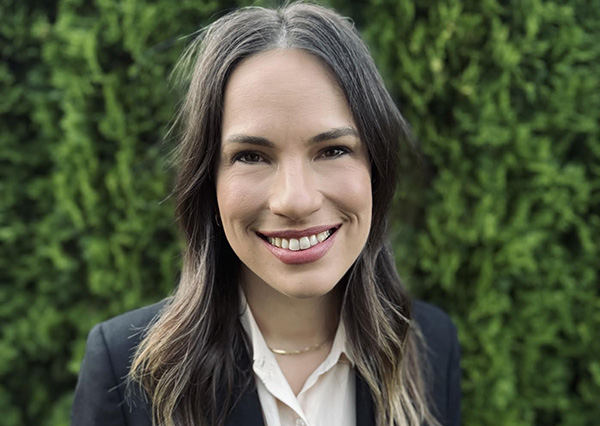
 Chris Harsell, Graduate Program Director (DNP-FNP) program, and associate professor, moved to the Pacific Northwest from North Dakota this summer. She was a nurse practitioner and chief clinical officer at a federally qualified health center. She said, “Most of my nurse practitioner career has been working in primary care at a federally qualified health center in a rural state. My passion is working with people with substance use disorders.” Harsell has been teaching in some capacity since she finished graduate school in 1999; undergraduate, graduate, clinical, classroom, and online.
Harsell also worked with a few grant funded teams at the University of North Dakota focused on substance use and disorder prevention and treatment. Her career has spanned over twenty-five years where she worked as a float pool nurse and in the PACU primarily in hospitals.
After meeting the faculty and staff and learning more about the School of Nursing and Health Innovations and how they use simulations, their innovative teaching, and their dedication to the students, she was sold. She knew she wanted to be a part of University of Portland and we are glad she is here.
Her background will help shape this program. She said, “As a clinician and administrator, I learned what qualities organizations are looking for in their future hires. I want to make sure the next generation of nurse practitioners is prepared to practice and lead in our ever-changing healthcare landscape.”
Harsell’s plans involve intentional growth and finding ways to make the program sustainable. She hinted at adding a new master’s level nursing program with the goal of a Fall ’27 enrollment cohort. For her, success in the new position is student-centered and community focused.
She said, “Success to me looks like a student body that is eager to advance their careers and is engaged on campus and in their community. It involves faculty and alumni working to improve the health of our communities.”
The Doctor of Nursing Practice, Family Nurse Practitioner Program at UP
Chris Harsell, Graduate Program Director and Associate Professor, answers some questions about the DNP-FNP program at University of Portland.
Is there a difference between the University of Portland Doctor of Nursing Program-Family Nurse Practitioner (DNP-FNP) program and an FNP program somewhere else?
We keep our cohorts intentionally smaller to ensure faculty student mentoring and time to develop relationships. Our program is flexible with a hybrid model for working professionals. We offer 1-3 hands on immersion weekends each term with time for experiential learning, case-based discussion and time in our state-of-the-art simulation lab.
What is the difference between a DNP vs. an MSN?
One of the many things I love about nursing is that it is a versatile field. There are many paths to reaching your goals.
As a nurse who has earned both a master's degree and a Doctor of Nursing Practice (DNP), I appreciate the value of both. Choosing your degree depends on what your career goals are. The master's degree is typically focused on direct clinical practice, while the DNP is a terminal degree focused on patient care, leadership, policy, and translating research into practice.
The DNP and MS degrees are just two of those paths. There is also a PhD and an EdD (UP has an EdD in Nursing Education and Leadership).
How will the DNP-FNP position students for leadership?
The courses in our program help students build a foundation in advanced clinical practice, system-level thinking, policy and leadership. Throughout the program, students have opportunities to identify and evaluate system challenges, discern evidence-based strategies, and develop solutions. These experiences prepare graduates to influence change, collaborate with interprofessional teams, and to lead systems level initiatives.
What are clinicals like for a DNP-FNP student? Over the course of the 3-year program, students will complete 900 direct patient care hours in a variety of settings. The scope of practice for a family nurse practitioner is all ages (infants to adults through end of life), so we work to provide clinical experiences across the lifespan.
In addition to that, students will spend about 100 hours working on a practice improvement project which is the culmination of their doctoral learning. During this time, students identify a clinical problem, appraise the evidence, implement and evaluate a change, and disseminate the findings.
Is there anything else about this program that sets UP apart from others out there?
In the brief time I have been at University of Portland, I have seen many things that set us apart from other programs. I already feel a powerful sense of community and connection, among faculty, staff, and students. The people here live the UP values with each other and with students every day. This is a school and a program that values you as a person and is invested in your success.
Resources
Learn more about our Graduate Nursing Programs
Related Posts
College of Arts and Sciences
Shiley School of Engineering
School of Education
School of Nursing and Health Innovations
Welcoming Our New Faculty
School of Nursing and Health Innovations
Graduate School
Developing Clinicians Our Communities Need Most

Alumni and Advancement
School of Nursing and Health Innovations
Student Success